MENILAI KLAIM GOLDEN RATIO PADA JARAK ANTARBUKU KANGKUNG: DESAIN AKTIVITAS INQUIRY-STEM UNTUK PEMBELAJARAN RASIO
DOI:
https://doi.org/10.35706/sjme.v10i2.13601Abstrak
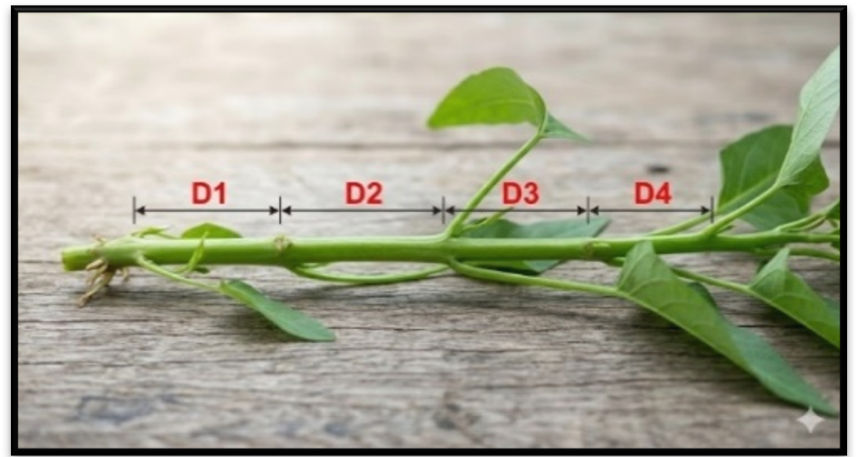
Klaim golden ratio pada alam sering digunakan untuk membangun konteks pembelajaran matematika, tetapi klaim tersebut perlu diuji dengan definisi variabel dan analisis yang tepat. Penelitian ini bertujuan: (1) mendeskripsikan pola lima jarak antarbuku berurutan pada 30 batang kangkung, (2) menguji kedekatan rasio pasangan jarak terhadap φ = 1,618, dan (3) menerjemahkan temuan menjadi aktivitas inquiry-STEM untuk pembelajaran rasio. Data terdiri atas 150 pengukuran jarak dan 120 rasio pasangan berdekatan. Analisis mempertahankan rasio berarah untuk membaca perubahan posisi serta menggunakan rasio simetris, yaitu jarak yang lebih panjang dibagi jarak yang lebih pendek, untuk menilai kedekatan terhadap φ. Perbedaan lima posisi diuji dengan Friedman, sedangkan rata-rata geometrik per batang dibandingkan dengan φ menggunakan Wilcoxon. Hasil menunjukkan perbedaan jarak antarbuku menurut posisi, χ²(4) = 22,744, p < 0,001, Kendall’s W = 0,190. Rata-rata aritmetika 120 rasio simetris sebesar 1,629 tampak dekat dengan φ, tetapi dipengaruhi rasio ekstrem 11,25 dan 11,67. Hanya 11 dari 120 rasio berada dalam toleransi 5%. Data tidak mendukung pola golden ratio yang konsisten. Nilai pendidikan penelitian terletak pada penggunaan klaim yang tidak terkonfirmasi sebagai konteks untuk mengajarkan pengukuran, rasio resiprokal, dan argumentasi berbasis bukti melalui inquiry-STEM.
Unduhan
Referensi
Apriastuti, N. P. E., Putra, A. A. G., & Karnata, I. N. (2023). Respon pertumbuhan tanaman kangkung darat (Ipomoea reptans Poir.) terhadap dosis pupuk urea. 01(01), 45–49. https://doi.org/10.58878/jissiwirabuda.v1i1.186 [accessed July 1, 2026].
Ben-Chaim, D., Keret, Y., & Ilany, B. S. (2012). Ratio and proportion: Research and teaching in mathematics teachers’ education. Sense Publishers. https://doi.org/10.1007/978-94-6091-784-4 [accessed June 20, 2026].
Bergeron, F., & Reutenauer, C. (2019). Golden ratio and phyllotaxis, a clear mathematical link. Journal of Mathematical Biology, 78(1–2), 1–19. https://doi.org/10.1007/s00285-018-1265-3 [accessed June 20, 2026].
Campbell, S., Greenwood, M., Prior, S., Shearer, T., Walkem, K., Young, S., Bywaters, D., & Walker, K. (2020). Purposive sampling: Complex or simple? Research case examples. Journal of Research in Nursing, 25(8), 652–661. https://doi.org/10.1177/1744987120927206
Cao, X., Lu, H., Wu, Q., & Hsu, Y. (2025). Systematic review and meta-analysis of the impact of STEM education on students’ learning outcomes. Frontiers in Psychology, 1579474(August), 1–15. https://doi.org/10.3389/fpsyg.2025.1579474 [accessed June 20, 2026].
Faizah, S., Rahmawati, N. D., & Murniasih, T. R. (2021). Investigasi struktur argumen mahasiswa dalam pembuktian aljabar berdasarkan skema Toulmin. AKSIOMA: Jurnal Program Studi Pendidikan Matematika, 10(3), 1466–1476. https://doi.org/10.24127/ajpm.v10i3.3781 [accessed July 2, 2026].
Godin, C., Gole, C., & Douady, S. (2020). Phyllotaxis as geometric canalization during plant development. Development. https://doi.org/10.17226/13165 [accessed June 20, 2026].
Hasler, O., Blaser, S., & Nebiker, S. (2020). Performance evaluation of a mobile mapping application using smartphones and augmented reality frameworks. ISPRS Annals of the Photogrammetry, Remote Sensing and Spatial Information Sciences, V-2-2020, 741–747. https://doi.org/10.5194/isprs-annals-V-2-2020-741-2020 Hollander, M., Wolfe, D. A., & Chicken, E. (2014). Nonparametric statistical methods (3rd ed.). John Wiley & Sons.
Holm, S. (1979). A simple sequentially rejective multiple test procedure. Scandinavian Journal of Statistics, 6(2), 65–70. https://doi.org/10.2307/4615733
Limpert, E., Stahel, W. A., & Abbt, M. (2001). Log-normal distributions across the sciences: Keys and clues. BioScience, 51(5), 341–352. https://doi.org/10.1641/0006-3568(2001)051[0341:LNDATS]2.0.CO;2
National Research Council. (2012). A framework for K-12 science education: Practices, crosscutting concepts, and core ideas. The National Academies Press. https://doi.org/10.17226/13165 [accessed June 20, 2026].
OECD. (2022). PISA 2022 results (Volume I): The state of learning and equity in education: Vol. I. OECD Publishing. https://doi.org/10.1787/53f23881-en [accessed June 20, 2026].
Okabe, T. (2015). Biophysical optimality of the golden angle in phyllotaxis. Scientific Reports, 3–5. https://doi.org/10.1038/srep15358 [accessed June 20, 2026].
Okabe, T., Ishida, A., & Yoshimura, J. (2019). The unified rule of phyllotaxis explaining both spiral and non-spiral arrangements. Journal of the Royal Society Interface, 16(151), Article 20180850. https://doi.org/10.1098/rsif.2018.0850 [accessed June 20, 2026].
Prahmana, R. C. I., Sagita, L., Hidayat, W., & Utami, N. W. (2020). Two decades of realistic mathematics education research in Indonesia: A survey. Infinity Journal, 9(2), 223–246. https://doi.org/10.22460/infinity.v9i2.p223–246 [accessed June 20, 2026].
Revina, S., & Leung, F. K. S. (2019). How the same flowers grow in different soils? The implementation of realistic mathematics education in Utrecht and Jakarta classrooms. International Journal of Science and Mathematics Education, 17(3), 565–589. https://doi.org/10.1007/s10763-018-9883-1 [accessed June 20, 2026].
Risdiyanti, I., Zulkardi, & Putri, R. I. I. (2024). Ratio and proportion through realistic mathematics education and Pendidikan Matematika Realistik Indonesia approach: A systematic literature review. Jurnal Elemen, 10(1), 158–180. https://doi.org/10.1007/s11858-008-0125-9 [accessed June 20, 2026].
Royal Botanic Gardens, Kew. (2026). Ipomoea aquatica Forssk. Plants of the World Online. Retrieved June 14, 2026, from https://powo.science.kew.org/taxon/urn:lsid:ipni.org:names:268410-1 [accessed June 20, 2026].
Sembiring, R. K., Hadi, S., & Dolk, M. (2008). Reforming mathematics learning in Indonesian classrooms through RME. ZDM Mathematics Education, 40(6), 927-939. https://doi.org/10.1007/s11858-008-0125-9 [accessed June 20, 2026].
Shapiro, S. S., & Wilk, M. B. (1965). An analysis of variance test for normality (complete samples). Biometrika, 52(3–4), 591–611. https://doi.org/10.1093/biomet/52.3-4.591
Strauss, S., Janne, L., Prusinkiewicz, P., Miltos, T., Smith, R. S., & Smith, R. S. (2020). Phyllotaxis: Is the golden angle optimal for light capture? New Phytologist, 499–510. https://doi.org/10.1111/nph.16040
Teles, N., Ribeiro, T., & Vasconcelos, C. (2024). Exploring the golden ratio in nature by using a STEAM approach: A diagnostic and quasi-experimental study. Education Sciences. https://doi.org/10.3390/educsci14070705
Van Den Heuvel-Panhuizen, M., & Drijvers, P. (2020). Realistic mathematics education. In S. Lerman (Ed.), Encyclopedia of mathematics education (2nd ed., pp. 713-717). Springer. https://doi.org/10.1007/978-3-030-15789-0_170 [accessed June 20, 2026].
Wibowo, H. Y., & Sitawati. (2017). Respon tanaman kangkung darat (Ipomoea reptans Poir.) dengan interval penyiraman pada pipa vertikal. Plantropica: Journal of Agricultural Science, 2(2), 148–154. https://jpt.ub.ac.id/index.php/jpt/article/view/142 [accessed June 20, 2026].
Yin, X., & Tsukaya, H. (2022). Fibonacci spirals may not need the golden angle. Quantitative Plant Biology, 3, Article e13. https://doi.org/10.1017/qpb.2022.10 [accessed June 20, 2026].
Unduhan
Diterbitkan
Cara Mengutip
Terbitan
Bagian
Citation Check
Lisensi
Hak Cipta (c) 2026 Ika Meika, Rizki Amsyarul Firdaus, Ika Yunitasari, Asep Sujana

Artikel ini berlisensiCreative Commons Attribution-ShareAlike 4.0 International License.
Hak cipta dilindingi undang-undang berdasarkan Undang-undang Nomor 28 Tahun 2014 tentang Hak Cipta. Dilarang memperbanyak isi jurnal ini, baik sebagian maupun seluruhnya dalam bentuk apapun tanpa izin tertulis dari SJME (Supremum Journal of Mathematics Education) sebagai pemegang Hak Cipta terhadap seluruh isi dari jurnal tersebut.
Penulis yang menerbitkan jurnal ini setuju dengan persyaratan berikut:
- Penulis mempertahankan hak cipta dan memberikan hak jurnal tentang publikasi pertama dengan karya yang secara bersamaan dilisensikan di bawah Lisensi Atribusi Creative Commons yang memungkinkan orang lain membagikan karya tersebut dengan pengakuan dari karya penulis dan publikasi awal dalam jurnal ini.
- Penulis dapat memasukkan pengaturan kontrak tambahan yang terpisah untuk distribusi non-eksklusif dari versi terbitan jurnal tersebut (misalnya, kirimkan ke repositori institusional atau publikasikan dalam sebuah buku), dengan sebuah pengakuan atas publikasi awalnya di Jurnal ini.
- Penulis diizinkan dan didorong untuk memposting pekerjaan mereka secara online (misalnya di repositori institusional atau di situs web mereka) sebelum dan selama proses penyampaian, karena dapat menyebabkan pertukaran yang produktif, serta kutipan karya yang diterbitkan sebelumnya dan yang lebih lama.