Analysis Of Differential Equation Misconceptions Among Pre-Service Mathematics Teachers
DOI:
https://doi.org/10.35706/sjme.v10i1.13319Keywords:
Pre-service mathematics teachers, Misconceptions, Differential equationAbstract
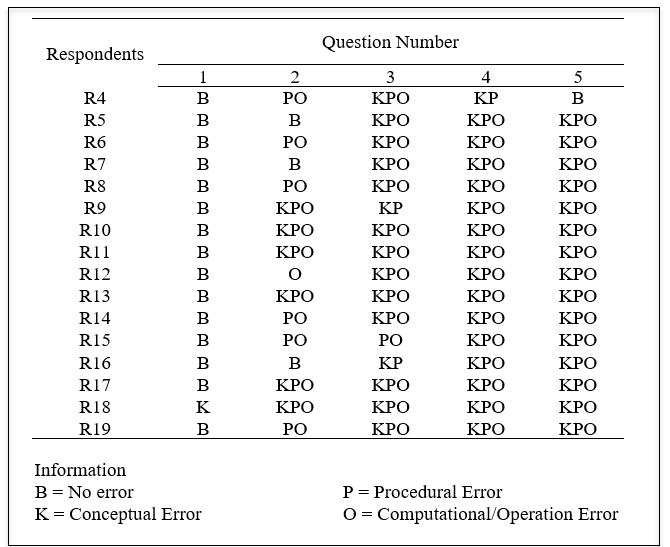
Differential Equations (DE) is a fundamental course for pre-service mathematics teachers as it supports the development of advanced calculus understanding and mathematical modeling skills. Despite its importance, many studies report that students still experience misconceptions when understanding and solving DE problems. This study aims to analyze the types and causes of misconceptions among pre-service mathematics teachers in solving DE problems. A descriptive qualitative approach was employed involving 19 mathematics education students from two private universities in Banten. The research instruments consisted of misconception tests in the form of true–false and essay questions, in-depth interviews, and focus group discussions (FGDs). Data analysis was conducted through identifying errors, classifying misconception types, and triangulating data sources. The findings revealed that procedural misconceptions were the most dominant, with an average of 72.63%, followed by computational misconceptions at 67.37% and conceptual misconceptions at 54.74%. Procedural errors mainly occurred in applying separation of variables, performing integration, and checking exact conditions, while conceptual errors were related to understanding variable relationships and the meaning of DE solutions. These results indicate that students’ understanding remains fragmented and not fully integrated. Therefore, instructional strategies are needed that balance conceptual understanding, procedural mastery, and computational accuracy in Differential Equations learning.
Downloads
References
Afri, L. D. & Reflina. (2024). Self Concept Mahasiswa UIN Sumatera Utara Medan pada Mata Kuliah Persamaan Diferensial Elementer. Lattice Journal : Journal of Mathematics Education and Applied, 4(2), 117–130. https://doi.org/10.30983/lattice.v4i2.8756
Boyce, W. E., DiPrima, R. C., & Meade, D. B. (2017). Elementary differential equations. John Wiley & Sons.
Budi, B. S., Nusantara, T. N., Subanji, S. S., & Susiswo, S. S. (2020). Analisis kesalahan newman siswa dalam menyelesaikan soal nilai mutlak dan scaffolding-nya. Jurnal Pendidikan Matematika Undiksha, 11(2). https://doi.org/10.23887/jjpm.v11i2.24732
Creswell, J. W. (2019). Research Design: Qualitative, Quantitative, and Mixed Method Approaches. Sage Publications.
Delic, G. (2025). Numerical solution of ordinary differential equations. In Guide to Numerical Algorithm Design and Development: Including Legacy Examples from Fortran and MathCAD in High Precision (pp. 197-232). Cham: Springer Nature Switzerland. https://doi.org/10.1007/978-3-031-90178-2_9
Dorner, C., Ableitinger, C. & Krammer, G. (2025). Revealing the nature of mathematical procedural knowledge by analysing students’ deficiencies and errors. International Journal of Mathematical Education in Science and Technology. https://doi.org/10.1080/0020739X.2024.2445666
Jameson, G., Machaba, M. F. & Fasinu, V. G. (2024). Misconceptions and Errors Among Grade 12 Students When Learning Differentiation Rules: A Case Study. Mathematics Education Journal, 8(2), 221–243. https://doi.org/10.22219/mej.v8i2.33081
Lin, T. H., Riccomini, P. J. & Liang, Z. (2025). Mathematical Error Patterns of Students With Mathematics Difficulty: A Systematic Review. In Learning Disability Quarterly. SAGE Publications Inc. https://doi.org/10.1177/07319487241310873
Lubis, T. A. (2025). Penerapan Metode Numerik dalam Penyelesaian Persamaan Diferensial. Pentagon: Jurnal Matematika dan Ilmu Pengetahuan Alam, 3(1), 131-137. https://doi.org/10.62383/pentagon.v3i1.421
Makamure, C. & Jojo, Z. M. (2022). An analysis of errors for pre-service teachers in first order ordinary differential equations. Eurasia Journal of Mathematics, Science and Technology Education, 18(6). https://doi.org/10.29333/ejmste/12074
Marcel, H., Sihotang, W., Sitindaon, D. M., Maruli, N., Saing, T., Grace, L., Silalahi, L., Sinaga, D., Simanullang, M. C., Studi, P., Matematika, P., Matematika, F., Ilmu, D., Alam, P. & Medan, U. N. (2025). Analisis Miskonsepsi Mahasiswa dalam Menyelesaikan Soal Supremum dan Infimum berdasarkan Teori Newman. SCIENCE : Jurnal Inovasi Pendidikan Matematika Dan IPA, 5(2), 591–606. https://jurnalp4i.com/index.php/science
Meika, I., Pratidiana, D., & Safitri, E. (2022). Analisis Kemampuan Pemecahan Masalah Matematis Siswa Kelas VII Dalam Menyelesaikan Soal Cerita Pada Materi Himpunan. SJME (Supremum Journal of Mathematics Education), 6(1), 75-84. https://doi.org/10.35706/sjme.v6i1.5764
Meika, I., Sartika, N. S., Sujana, A., Jarinah, Hakim, Z., Windiarti, I. S. & Hendra. (2025). E-didactics design of differential calculus based on TPACK to overcome learning obstacles for mathematics pre-service teachers. Infinity Journal, 14(3), 733–752. https://doi.org/10.22460/infinity.v14i3.p733-752
Meika, I., Solikhah, E. F. F., Yunitasari, I. & Sujana, A. (2023). Efektivitas LKPD Berbasis RME terhadap Kemampuan Pemahaman Konsep Ditinjau dari Ketuntasan Belajar. SJME (Supremum Journal of Mathematics Education), 7(2), 211–221. https://doi.org/10.35706/sjme.v7i2.9314
Meika, I., Suciyati Sartika, N. & Sujana, A. (2025). Desain E-Didaktis Aljabar untuk Mengatasi Learning Obstacle Siswa MTs. SJME (Supremum Journal of Mathematics Education), 09(01), 103–115. https://doi.org/10.35706/sjme.v9i1.119
Msomi, A. M., & Bansilal, S. (2022). Analysis of Students' Errors and Misconceptions in Solving Linear Ordinary Differential Equations Using the Method of Laplace Transform. International Electronic Journal of Mathematics Education, 17(1). https://doi.org/10.29333/iejme/11474
Noor, N. L. A. (2022). Scaffolding process based on error analysis in solving the problem: Second order differential equation. Jurnal Pendidikan Matematika (Kudus), 5(1), 79.
Muttaqi, U., Kartono, K., & Karomah Dwidayanti, N. (2021). Diagnostic Analysis of Newman’s Types of Students’ Error in Finishing Questions of Mathematical Problem Solving. Unnes Journal of Mathematics Education Research, 10(A), 32-40. Retrieved from https://journal.unnes.ac.id/sju/ujmer/article/view/34302
Rasmussen, C. , & Keene, K. (2019). Meaning for differential equations: Linking multiple representations. International Journal of Mathematical Education in Science and Technology, 50(8), 1216–1234.
Sari, H. M. & Ekasatya, A. A. (2020). Jurnal Pendidikan Matematika Analisis Miskonsepsi Siswa SMP pada Materi Operasi Hitung Bentuk Aljabar. Mosharafa: Jurnal Pendidikan Matematika, 9(3), 439–450. http://journal.institutpendidikan.ac.id/index.php/mosharafa
Shimizu, Y. & Kang, H. (2025). Research on classroom practice and students’ errors in mathematics education: a scoping review of recent developments for 2018-2023. ZDM - Mathematics Education, 57(4), 695–710. https://doi.org/10.1007/s11858-025-01704-0
Sumargiyani. (2025). Analisis Jenis dan Penyebab Kesalahan Mahasiswa dalam Soal PersamaanDiferensial Orde N. JUPIKA: Jurnal Pendidikan Matematika Universitas Flores, 8(1), 121–129.
Wardhani, T. A. W., & Argaswari, D. P. (2022). HIGH SCHOOL STUDENTS'ERROR IN SOLVING WORD PROBLEM OF TRIGONOMETRY BASED ON NEWMAN ERROR HIERARCHICAL MODEL. Infinity Journal, 11(1), 87-102. https://doi.org/10.22460/infinity.v11i1.p87-102
Yarman, Y., Murni, D., & Tasman, F. (2025). Implementation of SOLO taxonomy and Newman error analysis in first-order differential equation. Infinity Journal, 14(3), 695-710. https://doi.org/10.22460/infinity.v14i3.p695-710
Downloads
Published
How to Cite
Issue
Section
Citation Check
License
Copyright (c) 2026 Ika Meika, Asep Sujana

This work is licensed under a Creative Commons Attribution-ShareAlike 4.0 International License.
Authors who publish with this journal agree to the following terms:
- Authors retain copyright and grant the journal right of first publication with the work simultaneously licensed under a Creative Commons Attribution License that allows others to share the work with an acknowledgment of the work's authorship and initial publication in this journal.
- Authors are able to enter into separate, additional contractual arrangements for the non-exclusive distribution of the journal's published version of the work (e.g., post it to an institutional repository or publish it in a book), with an acknowledgment of its initial publication in this journal.
- Authors are permitted and encouraged to post their work online (e.g., in institutional repositories or on their website) prior to and during the submission process, as it can lead to productive exchanges, as well as earlier and greater citation of published work (See The Effect of Open Access).