Academic Self-Concept and Mathematical Computation on Geometric Sequences and Series: The Confirmatory Factor Analysis
DOI:
https://doi.org/10.35706/sjme.v10i1.13120Keywords:
Abstraction, academic self-concept, confirmatory factor analysis, self-confidence, mathematical computationAbstract
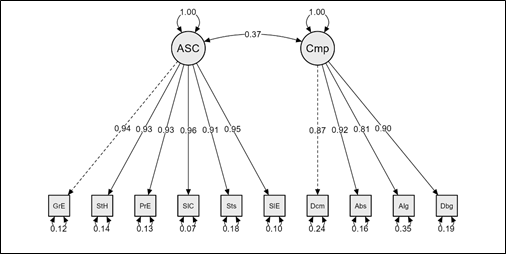
The purpose of this study was to investigate the relationship between academic self-concept and mathematical computation in the field of geometry, particularly on geometric sequences and series. This study employed a quantitative correlational design using Confirmatory Factor Analysis (CFA). Data were collected through a mathematical computation test consisting of eight essay items and an academic self-concept questionnaire administered to 200 senior high school students in Bogor Regency. The results indicated a good model fit, as reflected by the fit indices (CFI = 0.994, TLI = 0.992, and RMSEA = 0.0463). Academic self-concept was significantly associated with mathematical computation, with a correlation coefficient of 0.37. The mathematical computation construct demonstrated strong reliability and validity (CA = 0.923, CR = 0.929, AVE = 0.781), with abstraction as the most dominant factor (0.917). Meanwhile, the academic self-concept construct showed CA = 0.968, CR = 0.977, and AVE = 0.889, with self-confidence identified as the most dominant factor (0.964). These findings indicate that students’ self-confidence plays a crucial role in supporting abstraction in mathematical computation. Therefore, it is recommended that mathematics instruction should emphasize learning activities that strengthen students’ academic self-confidence and promote abstraction skills to improve mathematical problem-solving performance.
Downloads
References
Alkhateeb, H. M., Abushihab, E. F., Alkhateeb, B. H., & Alkhateeb, R. H. (2022). Academic Self-concept and its Relationship to Academic Achievement among University Students. International Journal on Social and Education Sciences, 4(4), 517–528. https://doi.org/10.46328/ijonses.342
Arens, A. K., Jansen, M., Preckel, F., Schmidt, I., & Brunner, M. (2021a). The Structure of Academic Self-Concept: A Methodological Review and Empirical Illustration of Central Models. Review of Educational Research, 91(1), 34–72. https://doi.org/10.3102/0034654320972186
Arens, A. K., Jansen, M., Preckel, F., Schmidt, I., & Brunner, M. (2021b). The Structure of Academic Self-Concept: A Methodological Review and Empirical Illustration of Central Models. Review of Educational Research, 91(1), 34–72. https://doi.org/10.3102/0034654320972186
Asfiana, A., Fitriyani, F., & Rokhimawan, M. A. (2024). Analisis Tantangan dan Kelebihan Pembelajaran Berbasis Teknologi Informasi dan Komunikasi pada Kurikulum Merdeka di Sekolah Dasar [Analysis of the Challenges and Advantages of Information and Communication Technology-Based Learning in the Merdeka Curriculum at Elementary Schools]. Ideguru: Jurnal Karya Ilmiah Guru, 10(1), 187–193. https://doi.org/10.51169/ideguru.v10i1.1215
Astuti, A., Suryawati, E., Suanto, E., Yuanita, P., & Noviana, E. (2025). Charting a course: Exploring computational thinking skills in statistics content among junior high school students. Journal of Pedagogical Research. https://doi.org/10.33902/JPR.202531653
Azizah, N. I., Roza, Y., & Maimunah, M. (2022). Computational thinking process of high school students in solving sequences and series problems. Jurnal Analisa, 8(1), 21–35. https://doi.org/10.15575/ja.v8i1.17917
Blegur, J. (2020). Soft Skills untuk Prestasi Belajar: Disiplin Percaya diri Konsep diri akademik Penetapan tujuan Tanggung jawab Komitmen Kontrol diri [Soft Skills Supporting Academic Achievement: Discipline, Self-Confidence, Academic Self-Concept, Goal Setting, Responsibility, Commitment, and Self-Regulation]. SCOPINDO MEDIA PUSTAKA. https://books.google.co.id/books?id=mDvPDwAAQBAJ
Bowers, J., Eidin, E., Stephens, L., & Brennan, L. (2023). Examining Student Testing and Debugging Within a Computational Systems Modeling Context. Journal of Science Education and Technology, 32(4), 607–628. https://doi.org/10.1007/s10956-023-10049-w
Buhaerah, B., Nasir, M., Busrah, Z., & Aras, A. (2023). Scaffolding on Sequence and Series Learning for Didactic Anticipation. SJME (Supremum Journal of Mathematics Education), 7(1), 69–82. https://doi.org/10.35706/sjme.v7i1.7019
Brown, T. A. (2015). Confirmatory factor analysis for applied research (2nd ed.). Guilford Press.
Byrne, B. M. (2016). Structural Equation Modeling With AMOS. Routledge. https://doi.org/10.4324/9781315757421
Calhoun, J. F., & Acocella, J. R. (1983). Psychology of Adjustment and Human Relationships. Random House. https://books.google.co.id/books?id=5NZv_c84zz0C
Castro, R. C, Castillo, L. F. O., & Martínez, C. H. (2025). Computational thinking training and its effects on working memory, flexibility, and inhibition: Randomized controlled trial in fifth-grade children. Journal of Applied Developmental Psychology, 100, 101850. https://doi.org/10.1016/j.appdev.2025.101850
Chen, G., Zhang, J., Chan, C. K. K., Michaels, S., Resnick, L. B., & Huang, X. (2020). The link between student‐perceived teacher talk and student enjoyment, anxiety and discursive engagement in the classroom. British Educational Research Journal, 46(3), 631–652. https://doi.org/10.1002/berj.3600
Eren, E., Yada, A., Schwab, S., & Savolainen, H. (2025). Teacher student-specific self-efficacy and its impact on students’ academic self-concept, emotional well-being and social inclusion. Teaching and Teacher Education, 165, 105152. https://doi.org/10.1016/j.tate.2025.105152
Granero, A. G., Baena, A. E., Escaravajal, J. C., & Baños, R. (2021). Validation of the Academic Self-Concept Scale in the Spanish University Context. Education Sciences, 11(10), 653. https://doi.org/10.3390/educsci11100653
Hair, J. F. , Black, W. C. , Babin, B. J. , & Anderson, R. E. (2008). Multivariate Data Analysis. Pearson Education Inc.
Hair, J. F., Risher, J. J., Sarstedt, M., & Ringle, C. M. (2019). When to use and how to report the results of PLS-SEM. European Business Review, 31(1), 2–24. https://doi.org/10.1108/EBR-11-2018-0203
Imami, A. I. (2023). Students Mathematical Communication Ability On Transformation Geometry. SJME (Supremum Journal of Mathematics Education), 7(1), 121–129. https://doi.org/10.35706/sjme.v7i1.8486
Martínez, M. L., Lévêque, O., Benítez, I., Hardebolle, C., & Zufferey, J. D. (2022). Assessing Computational Thinking: Development and Validation of the Algorithmic Thinking Test for Adults. Journal of Educational Computing Research, 60(6), 1436–1463. https://doi.org/10.1177/07356331211057819
Lance, C. E., Butts, M. M., & Michels, L. C. (2006). The Sources of Four Commonly Reported Cutoff Criteria. Organizational Research Methods, 9(2), 202–220. https://doi.org/10.1177/1094428105284919
Latifah, A. G., Quini, I. F., & Aripin, U. (2024). Kemampuan Berpikir Komputasi Ditinjau Dari Kecemasan Belajar Matematika [Computational Thinking Ability Viewed from Mathematics Learning Anxiety]. Teorema: Teori Dan Riset Matematika, 9(2), 351. https://doi.org/10.25157/teorema.v9i2.15019
Lehmann, T. H. (2024). How current perspectives on algorithmic thinking can be applied to students’ engagement in algorithmatizing tasks. Mathematics Education Research Journal, 36(3), 609–643. https://doi.org/10.1007/s13394-023-00462-0
Marifah, R. A., & Kartono, K. (2023). Kemampuan berpikir komputasi siswa SMP ditinjau dari self-efficacy pada model pembelajaran problem-based learning berbantuan Edmond [Computational Thinking Skills of Junior High School Students in Terms of Self-Efficacy through a Problem-Based Learning Model Assisted by Edmond]. PRISMA, Prosiding Seminar Nasional Matematika , 6, 480–489.
Mirolo, C., Izu, C., Lonati, V., & Scapin, E. (2021). Abstraction in Computer Science Education: An Overview. Informatics in Education, 20(4), 615–639. https://doi.org/10.15388/infedu.2021.27
Olmos, M. del C. G., Luque, M. S., Castán, M. G., & Portillo, R. S. (2023). Validation of Educational Quality as a Tool to Measure the Degree of Satisfaction of University Students. Education Sciences, 14(1), 2. https://doi.org/10.3390/educsci14010002
Passiatore, Y., Costa, S., Grossi, G., Carrus, G., & Pirchio, S. (2024). Mathematics self-concept moderates the relation between cognitive functions and mathematical skills in primary school children. Social Psychology of Education, 27(3), 1143–1159. https://doi.org/10.1007/s11218-023-09854-3
Peng, J., Hao, M., Chen, B., & Wang, M. (2025). Cultivating computational thinking in a STEM course through the ICDCO instructional model. Education and Information Technologies. https://doi.org/10.1007/s10639-025-13716-0
Qian, Y., & Choi, I. (2023). Tracing the essence: ways to develop abstraction in computational thinking. Educational Technology Research and Development, 71(3), 1055–1078. https://doi.org/10.1007/s11423-022-10182-0
Rosadi, D., Agustini, K., Dantes, G. R., & Sudatha, I. G. W. (2025). Integrasi Computational Thinking dalam Pendidikan Matematika: Tinjauan Literatur Sistematis [Integrating Computational Thinking into Mathematics Education: A Systematic Literature Review]. Indiktika : Jurnal Inovasi Pendidikan Matematika, 7(2), 650–664. https://doi.org/10.31851/indiktika.v7i2.15591
Rost, D. H., & Feng, X. (2024). Academic Self-Concept Wins the Race: The Prediction of Achievements in Three Major School Subjects by Five Subject-Specific Self-Related Variables. Behavioral Sciences, 14(1), 40. https://doi.org/10.3390/bs14010040
Rubab, A. Maqsood,A. & Mansoor, S. N. (2025). Self-Concept and Its Impact on Academic Performance Among High School Students. Journal of Health and Rehabilitation Research, 1–6. https://doi.org/10.61919/jhrr.v5i2.1722
Siswanto, Saimroh, Muthmainna, A., & Nurhijriah, N. (2024). The Role of Self-Confidence and Self-Awareness in Enhancing Academic Value: An SEM Analysis. International Journal of Social Learning (IJSL), 5(1), 189–201. https://doi.org/10.47134/ijsl.v5i1.310
Wang, L., & Yu, Z. (2023). Gender-moderated effects of academic self-concept on achievement, motivation, performance, and self-efficacy: A systematic review. Frontiers in Psychology, 14. https://doi.org/10.3389/fpsyg.2023.1136141
Wu, H., Guo, Y., Yang, Y., Zhao, L., & Guo, C. (2021). A Meta-analysis of the Longitudinal Relationship Between Academic Self-Concept and Academic Achievement. Educational Psychology Review, 33(4), 1749–1778. https://doi.org/10.1007/s10648-021-09600-1
Yasmin, N. (2025). Struktur Asosiasi antara Kemampuan Awal dan Kemampuan Berpikir Komputasi Matematis Siswa pada Sekolah Menengah Atas [The Structural Relationship between Prior Knowledge and Mathematical Computational Thinking Ability among Senior High School Students] [Master’s thesis].
Yu, Y., & Bailey, A. L. (2024). Self-concept in first grade and academic performance trajectories: roles of gender and dual-language immersion versus English-medium program enrollment. International Multilingual Research Journal, 1–20. https://doi.org/10.1080/19313152.2024.2387990
Yulianto, D., Juniawan, E. A., Junaedi, Y., Anwar, S., & Umami, M. R. (2024). Fostering Mathematical Motivation with Wordwall Media: A Study of the ARCS Model (Attention, Relevance, Confidence, and Satisfaction) Based on Sex Among High School Students. SJME (Supremum Journal of Mathematics Education), 8(2), 173–196. https://doi.org/10.35706/sjme.v8i2.11186
Zhao, Y., Zheng, Z., Pan, C., & Zhou, L. (2021). Self-Esteem and Academic Engagement Among Adolescents: A Moderated Mediation Model. Frontiers in Psychology, 12. https://doi.org/10.3389/fpsyg.2021.690828
Zulkarnaen, R. (2018). Peningkatan Kemampuan Pemodelan dan Penalaran Matematis serta Academic Self-concept Siswa SMA melalui Interpretation-Construction Design Model [Enhancing Senior High School Students’ Mathematical Modelling and Reasoning Skills and Academic Self-Concept through the Interpretation-Construction Design Model] [Doctoral dissertation, Universitas Pendidikan Indonesia]. UPI Repository.
Downloads
Published
How to Cite
Issue
Section
Citation Check
License
Copyright (c) 2026 Asya Khaula Aziza, Rika Mulyati Mustika Sari, Rafiq Zulkarnaen

This work is licensed under a Creative Commons Attribution-ShareAlike 4.0 International License.
Authors who publish with this journal agree to the following terms:
- Authors retain copyright and grant the journal right of first publication with the work simultaneously licensed under a Creative Commons Attribution License that allows others to share the work with an acknowledgment of the work's authorship and initial publication in this journal.
- Authors are able to enter into separate, additional contractual arrangements for the non-exclusive distribution of the journal's published version of the work (e.g., post it to an institutional repository or publish it in a book), with an acknowledgment of its initial publication in this journal.
- Authors are permitted and encouraged to post their work online (e.g., in institutional repositories or on their website) prior to and during the submission process, as it can lead to productive exchanges, as well as earlier and greater citation of published work (See The Effect of Open Access).